This project started with a tool that advisors technically needed, but no longer trusted. The quotation platform was central to the sales process: advisors used it to configure plans, compare scenarios and prepare client-facing proposals. In practice, many of them had moved part of that work to Excel because the legacy system crashed, felt rigid and created doubts around whether the final output would match what they had configured.
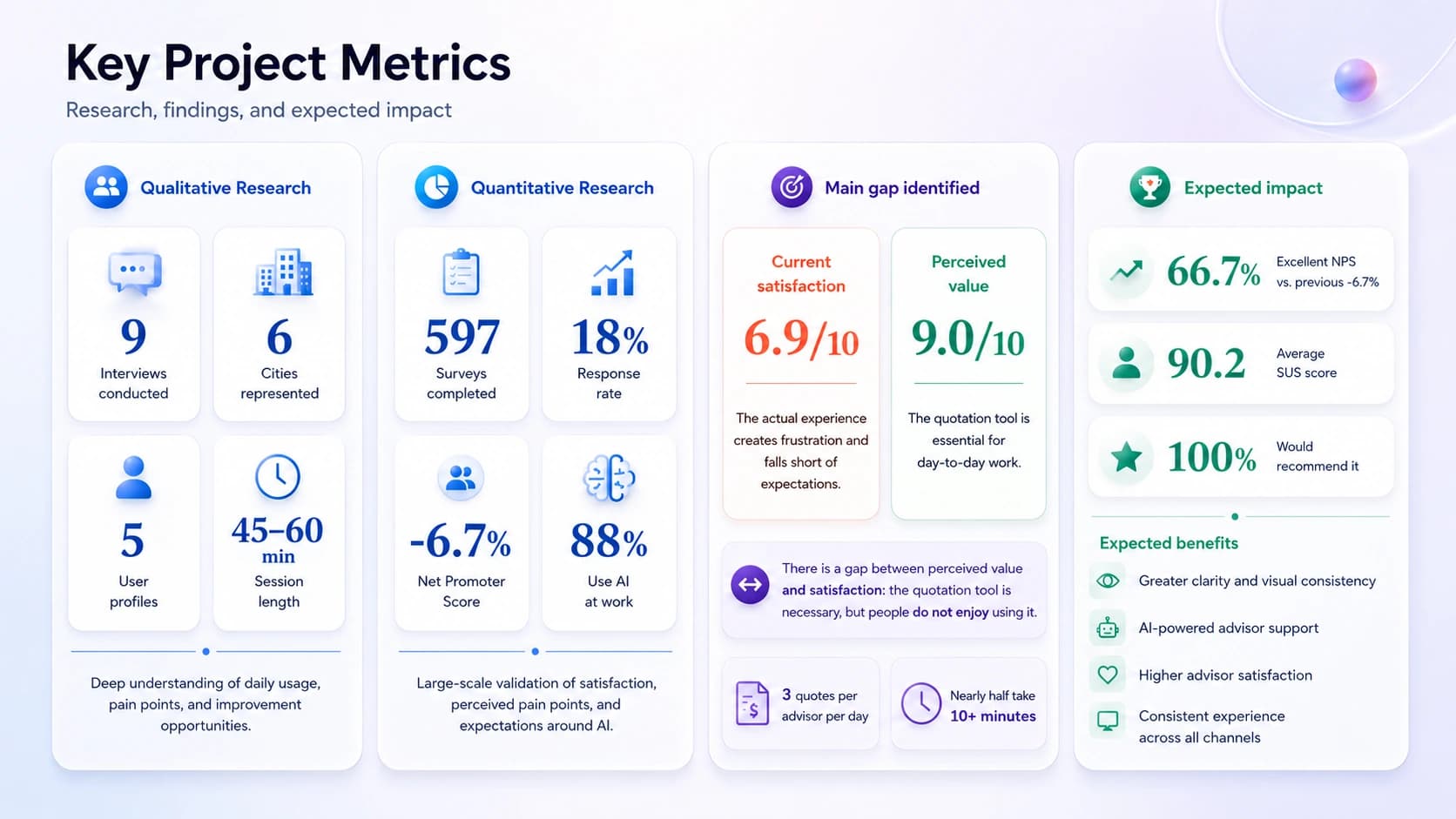
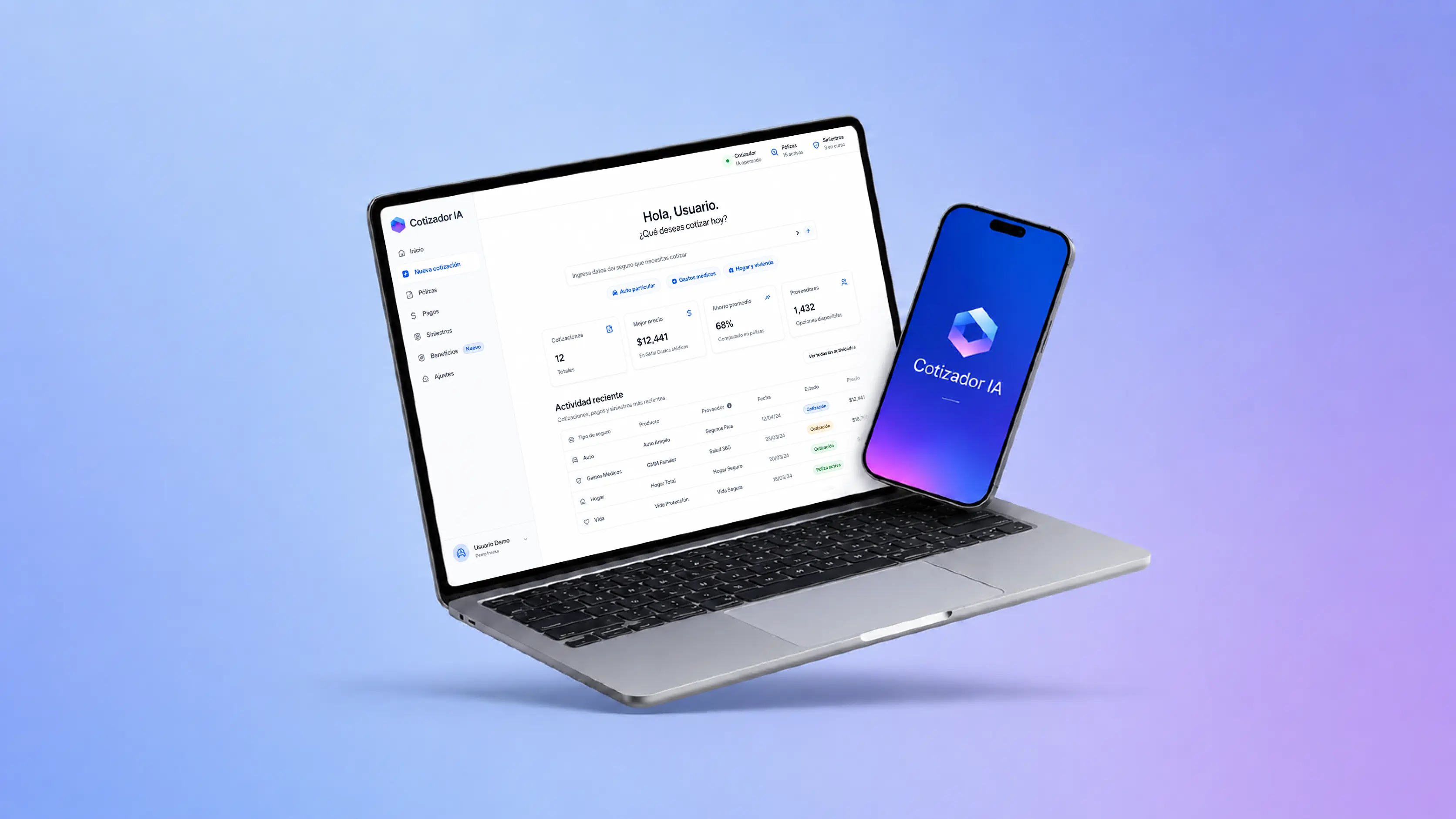
My role was to help rethink the experience from the ground up: understand how advisors actually sell, define the interaction architecture of the new quoting flow and design how AI should support the process without taking control away from the user. The result was a mobile-first quotation experience with AI-powered recommendations, real-time comparison, validation logic and clearer proposal generation. After validation, the tool moved from a negative NPS to a strongly positive one, with a 90.2 SUS score.
The client is one of the largest life insurance providers in its market. Its commercial model depends heavily on a national network of independent financial advisors who need to build credible, personalized quotations in front of clients.
That context mattered because the quotation tool was not a back-office system. It was part of the advisor's sales conversation. When the platform failed, the advisor did not just lose time. They lost confidence in front of the client.
The existing tool had several issues: crashes, inconsistent data between quotation and policy issuance, limited mobility, heavy forms and little clarity around how calculations were being made. Advisors had created their own workarounds, especially spreadsheets, because they felt they could control the process better outside the system. The challenge was not simply to modernize a legacy interface. The real problem was trust.
I led UX/UI and interaction design for the quotation experience. My work focused on four areas: structuring the full quotation flow, from client profiling to plan selection, comparison and proposal generation; defining how AI recommendations, conversational input and validation alerts should appear inside the advisor's natural workflow; translating advanced interaction concepts into clear UX specifications that product and engineering teams could actually build; and participating in usability testing with real advisors and turning findings into concrete design iterations.
I worked with strategy, research, data science and engineering teams. My main responsibility was making sure the product vision became an experience that was clear enough for advisors and realistic enough for implementation.
The tool had to earn trust again. Advisors had already learned not to depend on the old system for high-stakes moments. That made the design problem very different from a normal redesign. A cleaner interface was not enough. The product needed to show what was happening, explain why a recommendation made sense and reduce the feeling that the system could fail at any moment.
AI needed to support expertise, not replace it. One of the strongest requests from advisors was an AI feature that could suggest the right product for a client. But advisors are specialists. They do not want a black box telling them what to sell. That changed the design direction. AI could recommend, validate and accelerate, but the final decision had to stay with the advisor.
The ecosystem was fragmented. Quotation, policy issuance, client data and reporting lived in different places. The new interface had to feel like one coherent flow even if the backend reality was more complex. The work was about designing clarity on top of fragmentation.
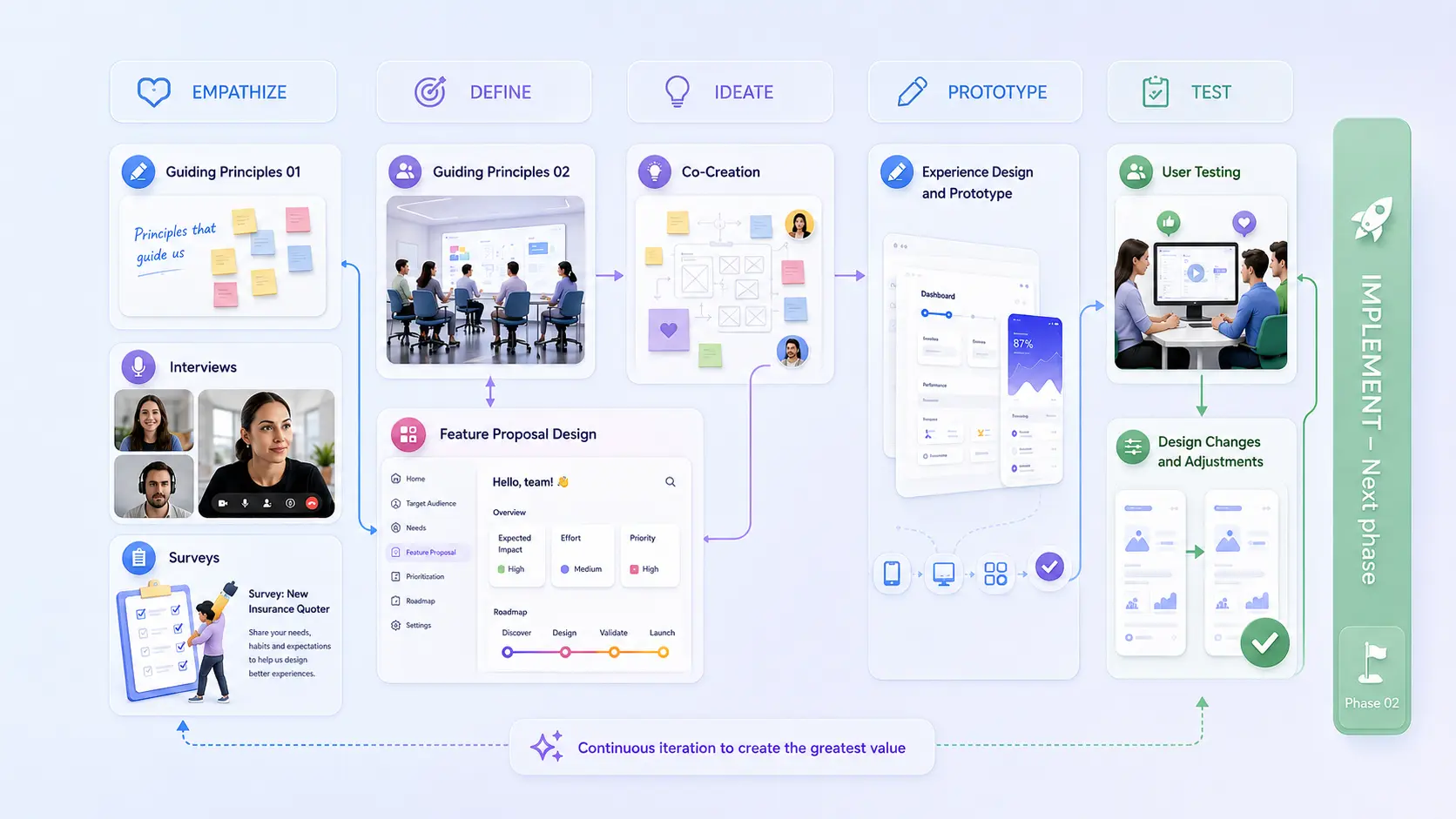
We started by understanding how advisors actually worked, not only what they said they needed, but what they did when the tool failed: the spreadsheets they built, the shortcuts they used, the information they double-checked and the moments where they avoided using the platform altogether. A key insight was that advisors were not asking for a better app. They wanted something closer to a working partner: a tool that could help them think through the right recommendation, compare alternatives and explain the proposal with confidence.
The research helped define a set of principles that guided the interface: make the system's logic visible; design for field work, not desk work; treat comparison as the core action; use AI to explain and validate, not to hide complexity; reduce uncertainty at the moments where advisors make decisions.
The AI layer was designed to appear where it could actually help. Recommendation cards appeared during plan selection. Validation alerts appeared when a configuration was incomplete or risky. Conversational input worked as a shortcut for advisors who already knew what they wanted. AI was not treated as a separate section of the product. It was part of the quotation process itself.
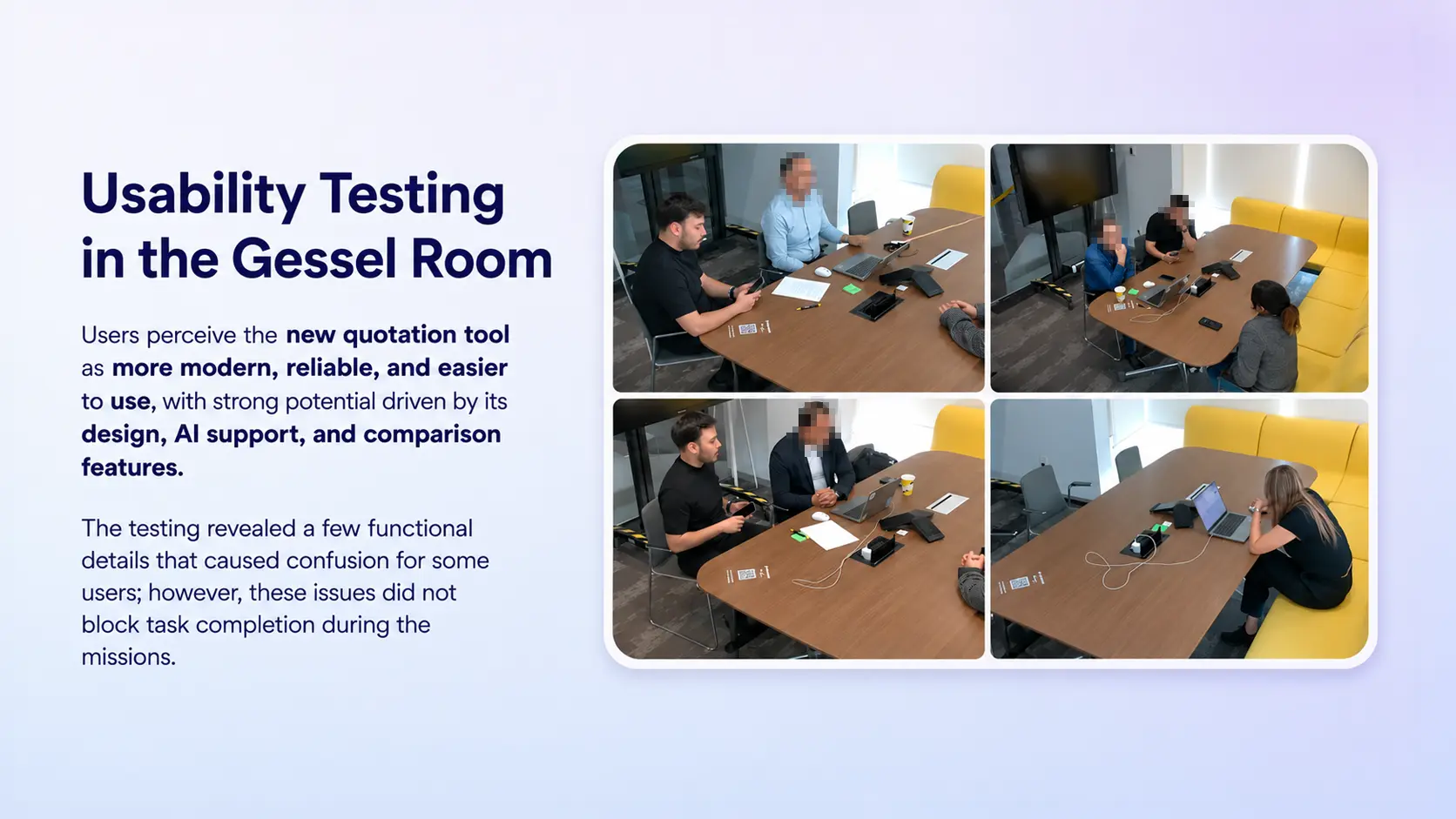
We validated the prototype in Gesell room sessions with real advisors. This confirmed that the new direction felt modern and clear, but also showed where the design needed more warmth, better hierarchy and simpler information architecture.
AI recommendations as reasoning cards. The original expectation was closer to the system telling the advisor the right plan. I pushed the design toward recommendation cards that explain the logic behind each suggestion. The advisor sees why a plan is recommended, what client variables were considered and where there may be uncertainty. The AI supports the decision, but does not own it. In a financial sales context, trust is more valuable than speed alone.
Conversational input as a shortcut, not the main flow. Conversational quoting was one of the most visible ideas, but I did not position it as the primary way to use the tool. For many advisors, structured fields gave more control and reduced the risk of mistakes. The conversational assistant worked better as an accelerator for experienced users. The design needed to work for different levels of digital confidence, not just for the most advanced users.
Real-time preview as a trust signal. The proposal preview was a direct response to a trust problem. If advisors could see the client-facing output update as they configured the quotation, they no longer had to wonder whether the system would generate something different at the end. Reducing that uncertainty was part of rebuilding adoption.
The redesigned experience changed how advisors perceived the tool. NPS moved from −6.7% to 66.7%, a 73-point swing. The prototype reached a 90.2 SUS score. One hundred percent of advisors in the validation cohort said they would recommend the tool to colleagues.
AI recommendations became one of the strongest proof points because they were useful without feeling like a black box. The interaction patterns created for this tool started to influence other internal product experiences at the same company.
The biggest lesson was that the most important design decisions happened before the screens looked finished. The research, the behavioral mapping and the way we translated advisor needs into product principles were what made the interface credible. The UI was the visible layer, but the real work was deciding what the product needed to make explicit, what it needed to simplify and where AI actually created value.
This project also reinforced how I think about AI in enterprise tools. AI works better when it respects the user's expertise. Once the product says here is what I see, here is why, you decide. The experience becomes more useful and easier to trust.
AI that does not know its limits becomes a liability. We designed the AI layer to be visibly confident only when the data supported it. When it was not sure, it got out of the way. That restraint was harder to get right than any feature we shipped.
Capabilities
Project
Quoting, rewired.
Industry
Insurance
Year
2024–2025
Role
UX/UI & Interaction Design Lead
Status
Anonymized (NDA)