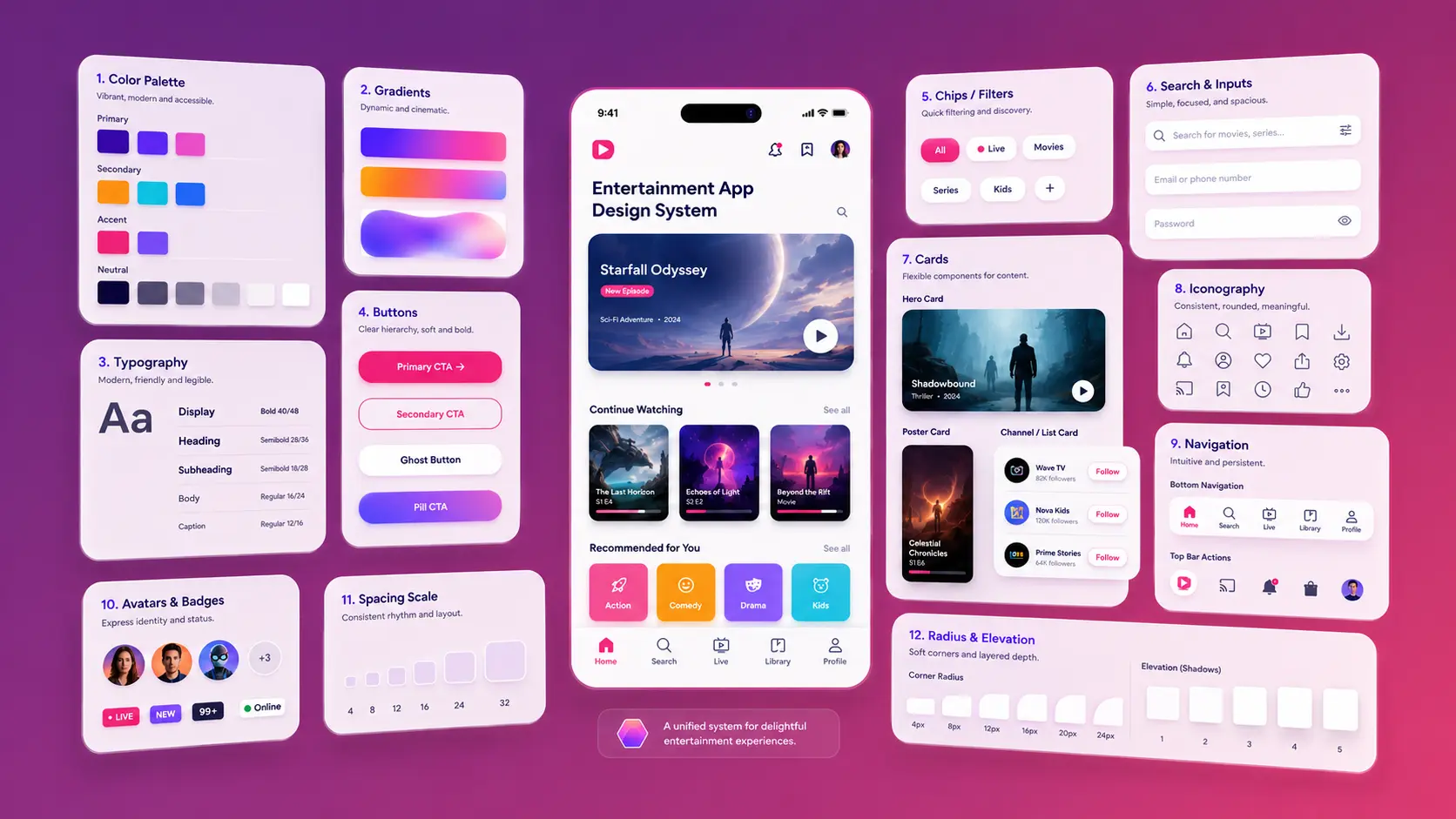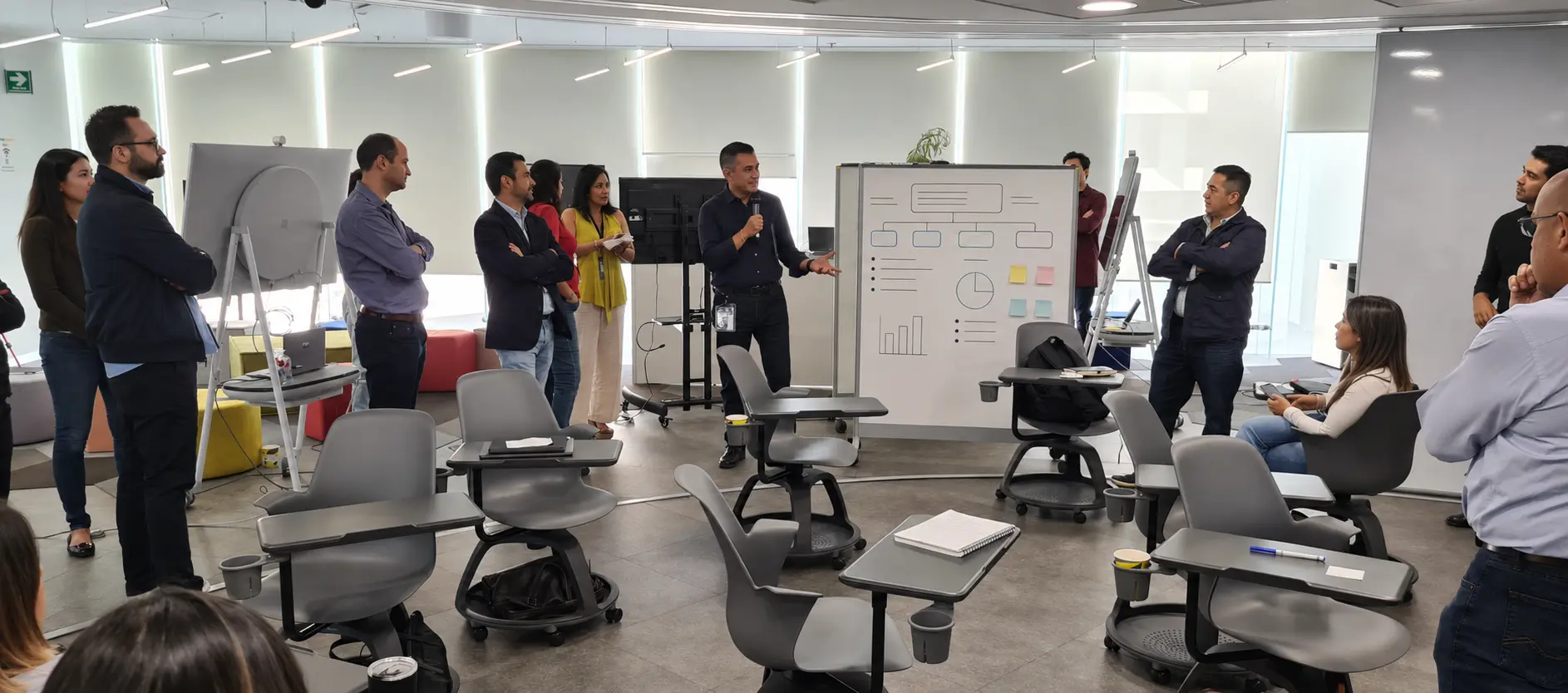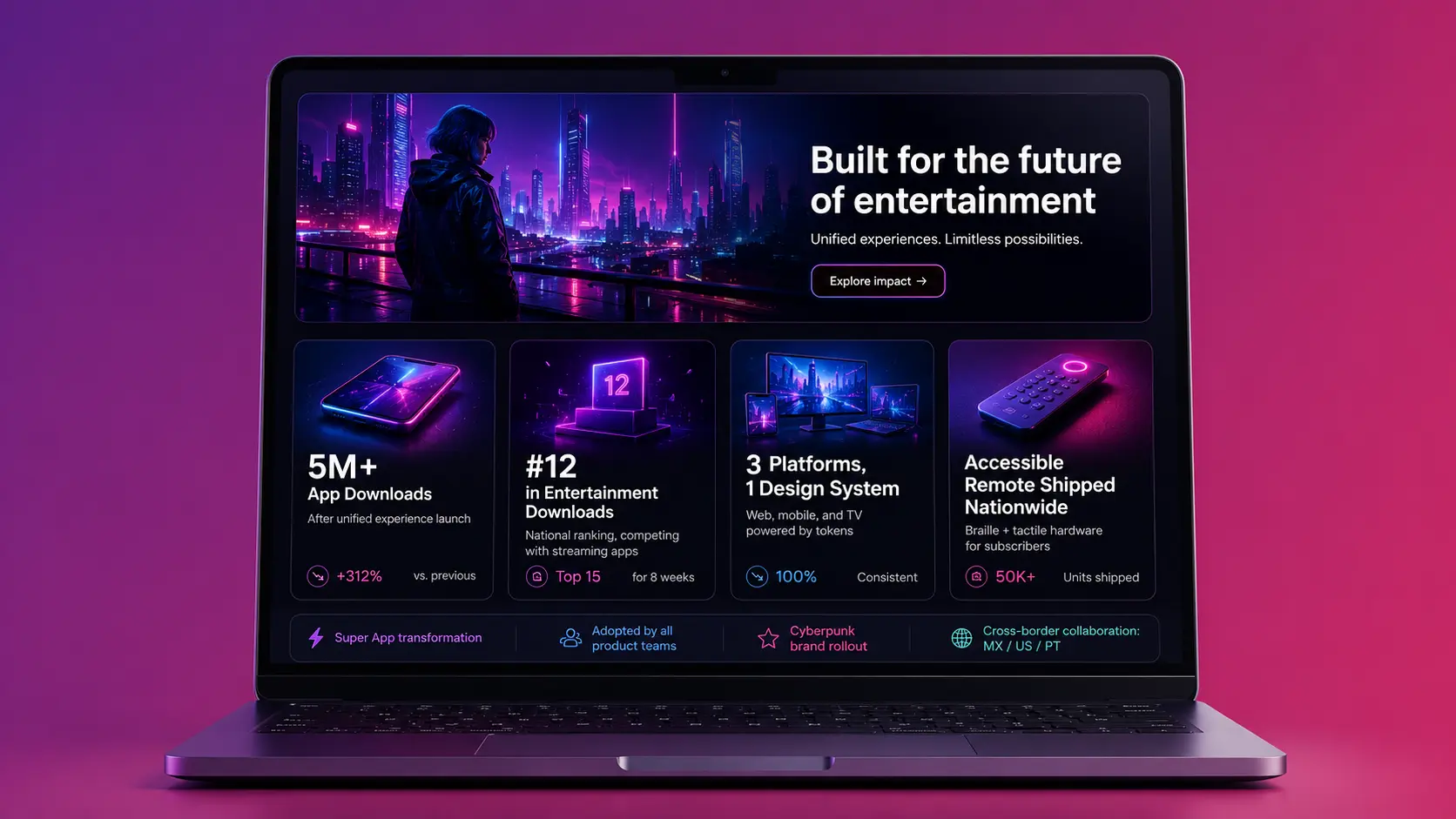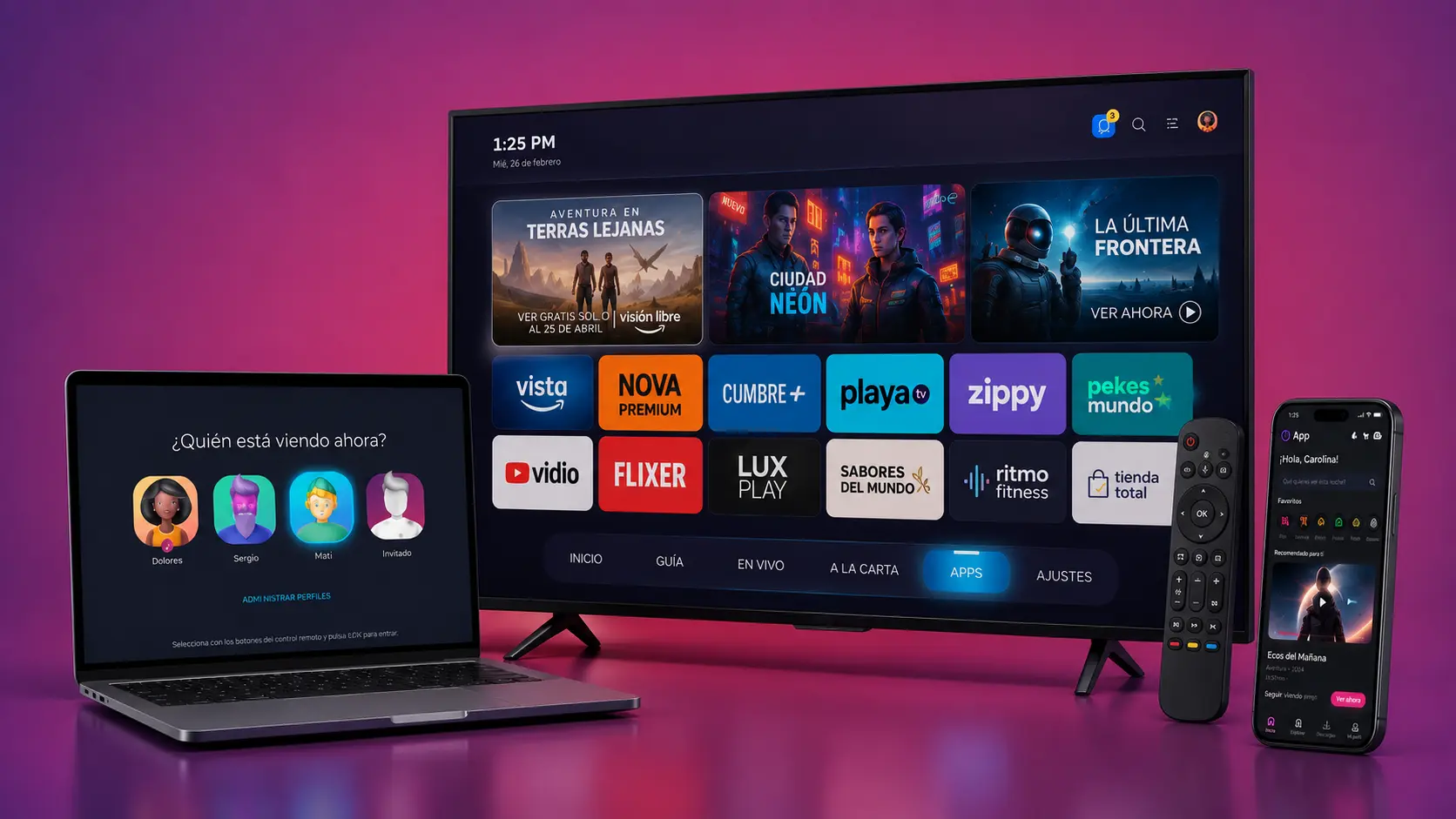
This project was about turning a fragmented digital ecosystem into one coherent product language.
The company had web, mobile and TV experiences that had grown separately. Each platform had its own patterns, rules and visual decisions. At the same time, the business was trying to evolve beyond traditional telecom services and become a broader digital ecosystem with entertainment, delivery, loyalty and financial services.
I led the design system work across that transformation. The goal was not just to make the screens look consistent. The real challenge was creating a system that could absorb a changing brand, support different interaction models and help several product teams move in the same direction.
The work also extended beyond the screen. The TV experience depended on a physical remote control, so the system had to connect digital interface decisions with hardware, accessibility and real living-room behavior.
The company was moving from a traditional telecom model into a larger digital ecosystem. That meant the product experience had to support much more than connectivity: entertainment, ecommerce, loyalty, digital services and customer support.
The problem was that the experience had been built by different teams at different times. Web, mobile and TV had different visual standards, different components and different interaction rules. Even basic actions could look and behave differently depending on the platform.
In parallel, the brand was also evolving. The new direction was more futuristic and technology-forward, with a stronger visual personality. That created another layer of complexity: the design system had to support change while the change was still happening.
This was the core tension of the project: build something stable enough for product and engineering, but flexible enough for a brand and business model in motion.
I led the design system architecture and helped translate the new brand direction into usable product decisions.
My work included defining the structure of the system: tokens, components, patterns and documentation, and creating UI standards that could work across web, mobile and TV without forcing every platform into the same mold. I translated brand decisions into scalable interface rules: color tokens, typography scales, spacing, states, motion principles and component behavior. I designed reusable patterns for telecom services, entertainment, ecommerce, loyalty, financial products and support flows.
I also supported the 10ft UI, where navigation, focus states and content density follow completely different rules from web or mobile, and participated in the redesign of the physical remote control, including tactile differentiation and Braille signals on key buttons. My work connected product, UX, engineering, research and creative teams across countries.
My responsibility was to keep the system usable for designers, understandable for engineers and useful for the business.
A website, a mobile app and a TV interface do not behave the same way. Web can handle dense layouts and hover states. Mobile depends on touch, thumb reach and limited space. TV is navigated with a remote control from several meters away, which makes focus states, reading distance and directional navigation critical. A single system could not mean one component copied everywhere. It needed shared logic with platform-specific behavior.
The brand was changing while the system was being built. A design system is often created after the brand is clear. Here, both things were moving at the same time. That made tokens essential: if color, spacing, typography and visual treatments were defined as reusable decisions, the system could adapt without redesigning every component from zero.
The product experience had a physical layer. The TV remote was not a secondary object. For many subscribers, it was the main way to interact with the ecosystem. Improving the TV interface without improving the remote would have left part of the experience unresolved. This forced the system to cross the edge of the screen.
Adoption was an organizational problem. Some teams had never used a design system before. Others had their own ways of working. A good library was not enough. The system needed governance, documentation and practical support so teams could adopt it because it helped them, not because someone told them to.
The work started with an audit: mapping inconsistencies across platforms. The same actions, components and flows appeared with different rules depending on where the user was. This audit made the fragmentation visible and gave the team a concrete reason to invest in a system rather than continue fixing screens one by one.
I structured the system in three layers. Tokens: base values covering color, typography, spacing, radius, shadows and other reusable decisions. Components: buttons, cards, inputs, modals, navigation and other interface elements with platform-specific variants. Patterns: recurring flows and behaviors, like onboarding, checkout, plan management, content browsing and support interactions. This structure mattered because the business was not designing one product. It was building an ecosystem.
For TV, I created a 10ft adaptation logic: same design language, but different rendering rules. Typography needed to scale differently. Cards needed clearer focus states. Layouts needed predictable directional navigation. Content density had to drop because the user was not sitting close to the screen. The key was separating the meaning of a component from its platform expression.
The remote control became one of the clearest examples of the project's logic. We worked on button layout, tactile differentiation and Braille signals on key buttons, helping users navigate by touch, in low-light environments and with different levels of visual ability. Accessibility was designed into the default product, not treated as a separate version.
Tokens before components. It would have been faster to start by building buttons and cards. I pushed for tokens first because the brand was still changing. That made early progress less visible, but it saved rework later. When a foundational brand value changed, the system could update from the base instead of manually fixing every screen. A system needs to survive change, not freeze a moment in time.
One system with platform variants. The easier route would have been to create three separate systems with similar principles. I chose one shared system with platform-specific behavior. That created more complexity upfront, but it made long-term consistency and maintenance much stronger. The user should feel one ecosystem, even when each platform behaves differently.
Accessibility as part of the default product. Braille signals and tactile textures were not part of the original brief. They emerged from thinking seriously about who uses the remote and how. Instead of treating accessibility as a special edition, we integrated it into the main product. Inclusive design is stronger when it improves the core experience for everyone.
Coaching adoption instead of forcing it. A design system can fail if it becomes a document that nobody wants to use. I focused on making adoption practical: usage guides, reviews, syncs with engineering and support for teams that were new to this way of working. A system only creates value when teams actually build with it.
The design system became the foundation for a broader digital and physical transformation. With 12M+ subscribers served, the app reached 5M+ downloads and ranked #12 in entertainment downloads nationally. Web, mobile and TV experiences were unified under one system. The physical remote control was redesigned as an extension of the same experience principles.
Product teams adopted shared components, patterns and documentation. Brand evolution could land across digital touchpoints faster because it was built into the system architecture. Accessibility decisions, including Braille signals and tactile textures, shipped in the default remote control. Teams across Mexico, the US and Portugal worked from a more aligned design language.
This project changed how I think about design systems. A design system is not mainly about making things look consistent. Its bigger value is helping a product ecosystem absorb change. Brands evolve. Platforms appear. Business models shift. Teams rotate. The system has to create enough structure so the product can keep moving without becoming fragmented again.
It also reinforced that digital experience does not end at the screen. In this project, the remote control was as important as the interface because it shaped how millions of people accessed the product. That physical layer made the system more real.
For me, the strongest design systems are not libraries. They are shared languages: built for teams, platforms and decisions. The governance model, the documentation, the contribution process: those are what determine whether the system survives beyond the people who built it.
Capabilities
Project
One system for a whole ecosystem.
Industry
Telecom & Entertainment
Year
2022–2023
Role
Design System Lead · UX/UI
Status
Public-friendly